SAILGOOD 三谷

Steel Toe vs Composite Toe Safety Shoes: Which One Is Better for Your Workforce?
Upload Time:
Jun 15, 2026
Choosing between steel toe and composite toe safety shoes can significantly impact worker safety, comfort, and productivity. This guide compares both options and helps PPE buyers make informed purchasing decisions.
Steel Toe vs Composite Toe Safety Shoes: A Complete Buyer's Guide for Industrial Safety
Safety shoes are one of the most important pieces of personal protective equipment (PPE) in industrial workplaces. When selecting protective footwear, buyers often face a common question:
Should I choose steel toe safety shoes or composite toe safety shoes?
Both options are designed to protect workers from impact and compression injuries, but they differ significantly in materials, weight, comfort, and workplace suitability.
This guide explains the differences between steel toe and composite toe safety shoes to help distributors, contractors, and PPE procurement professionals make the right purchasing decision.
What Are Steel Toe Safety Shoes?
Steel toe safety shoes contain a protective steel cap installed inside the toe area.
The steel cap is engineered to withstand heavy impacts and compression forces, helping protect workers from falling objects, rolling equipment, and workplace accidents.
Steel toe footwear has been the industry standard for decades and remains one of the most widely used forms of protective footwear worldwide.
Advantages of Steel Toe Safety Shoes
✔ Maximum impact protection
✔ Excellent compression resistance
✔ Proven long-term durability
✔ Cost-effective solution
✔ Suitable for heavy-duty industrial environments
Common Applications
- Construction Sites
- Oil & Gas Industry
- Mining Operations
- Manufacturing Plants
- Warehouses
- Logistics Centers
What Are Composite Toe Safety Shoes?
Composite toe safety shoes use non-metal materials instead of steel.
Common materials include:
- Fiberglass
- Carbon Fiber
- Kevlar
- Plastic Composites
These materials are engineered to meet safety standards while reducing weight.
Composite toe footwear has become increasingly popular in industries where worker comfort and mobility are important.
Advantages of Composite Toe Safety Shoes
✔ Lightweight design
✔ Better thermal insulation
✔ Non-metallic construction
✔ Airport-friendly
✔ Improved wearing comfort
Common Applications
- Electrical Work
- Warehousing
- Transportation
- Logistics
- Light Manufacturing
- Outdoor Service Industries
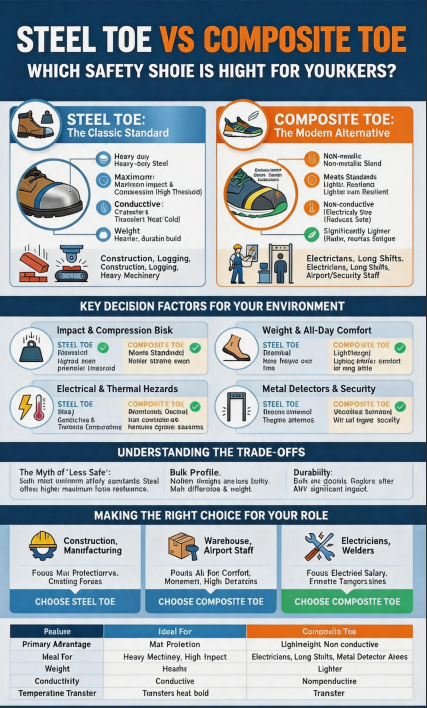
Key Differences Between Steel Toe and Composite Toe Safety Shoes
1. Protection Performance
Steel toe safety shoes generally provide the highest level of impact resistance.
However, modern composite toe safety shoes can also meet international safety standards such as EN ISO 20345 and ASTM requirements.
For most industrial applications, both options provide sufficient protection when properly certified.
2. Weight
Weight is one of the biggest differences.
Steel toe footwear is heavier because of the metal cap.
Composite toe footwear is significantly lighter, reducing fatigue during long working hours.
Workers who spend the entire day walking often prefer composite toe models.
3. Comfort
Composite toe safety shoes generally offer better comfort.
The lighter construction places less strain on the feet and legs.
For employees working 8–12 hour shifts, improved comfort can contribute to higher productivity and reduced fatigue.
4. Temperature Resistance
Steel conducts heat and cold.
In extremely hot or cold environments, steel toe shoes may become uncomfortable.
Composite materials provide better insulation and maintain more stable internal temperatures.
This makes composite toe safety shoes a preferred choice for outdoor workers and cold-climate applications.
5. Electrical Hazard Applications
Composite toe footwear contains no metal components.
As a result, it is often used in environments where electrical hazard protection is required.
Electricians and utility workers frequently choose composite toe safety shoes for this reason.
6. Cost Comparison
Steel toe safety shoes are typically more affordable.
The manufacturing process is mature, and steel components are widely available.
Composite toe safety shoes often have higher production costs because of advanced materials.
For large-volume procurement projects, steel toe footwear may offer a more economical solution.
Which Industries Prefer Steel Toe Safety Shoes?
Steel toe footwear remains the preferred option for:
Construction Industry
Heavy materials and tools create constant impact risks.
Mining Industry
Workers require maximum toe protection.
Oil & Gas Industry
Harsh environments demand durable safety footwear.
Heavy Manufacturing
Steel toe shoes provide reliable protection against workplace hazards.
Which Industries Prefer Composite Toe Safety Shoes?
Composite toe footwear is commonly used in:
Electrical Industry
Non-metallic protection is preferred.
Logistics and Warehousing
Workers walk long distances daily.
Transportation Industry
Lightweight footwear improves comfort.
Service and Maintenance Work
Mobility is often more important than maximum protection.
How PPE Buyers Should Make the Decision
When selecting safety footwear, buyers should evaluate:
Workplace Hazards
Assess impact, compression, and puncture risks.
Working Environment
Consider temperature, humidity, and electrical exposure.
Employee Comfort
Long working hours may favor lightweight footwear.
Budget Requirements
Compare total procurement costs and expected product lifespan.
Regulatory Standards
Verify compliance with local safety regulations.
Why Many Buyers Source Both Types
Many PPE distributors choose to stock both steel toe and composite toe safety shoes.
This allows them to serve:
- Construction Contractors
- Industrial Factories
- Warehouses
- Oilfield Operators
- Logistics Companies
Offering multiple options helps meet the needs of different industries and worker preferences.
Conclusion
Both steel toe safety shoes and composite toe safety shoes provide effective workplace protection when manufactured according to recognized safety standards.
Steel toe footwear remains the best choice for maximum protection and cost efficiency, while composite toe footwear offers superior comfort, lightweight performance, and non-metallic advantages.
Understanding the differences between these two types of protective footwear will help buyers make better purchasing decisions and improve workplace safety outcomes.
Relevant News



Product Category
Contact Us
3015, Building A2, Fuli International Finance Centre, Guicheng, Foshan, Guangdong, China


